Wednesday, 1 October 2014

Breakfast at Tiffany's

Breakfast at Tiffany’s

Breakfast at Tiffany’s is a 1961 film, based on the 1958 short novel, Breakfast at Tiffany’s, by Truman Capote. The romantic comedy was directed by Blake Edwards, produced by Martin Jurow and released by Paramount Pictures.  Audrey Hepburn played the leading role of naive and excitable Holly Golightly and was nominated for  an Academy Award for Best Actress. It is thought, by many, to be her most memorable and recognisable role; however the actress admitted that she found it very challenging to play the extrovert, Holly Golightly, as the character was so different from her own. The film was very well received by the audience and critics and was nominated for five Academy Awards, winning Best Original Score and Best Original Song, Moon River. 


In the film, Holly Golightly was a fun-loving and occasionally scatty young woman who escaped her poor, dysfunctional family to New York city in an attempt to become rich to support her much-loved brother, Fred. Getting ready for one of her many trips to Sing Sing prison, to check the ‘weather report’ from inmate Sally Tomato, she bumps into her new neighbour-tenant, Paul Varja, financially supported by an older woman nicknamed 2E, who instantly becomes intrigued by her. His love for Holly grows throughout the film, however Holly Golightly is on a constant hunt to find the next richest man she can marry as she thinks money will make her wild dreams come true. Paul stays by her side despite her rejecting his declaration of love, making her realise that the happiness of love is so much more rewarding than the happiness of money.  
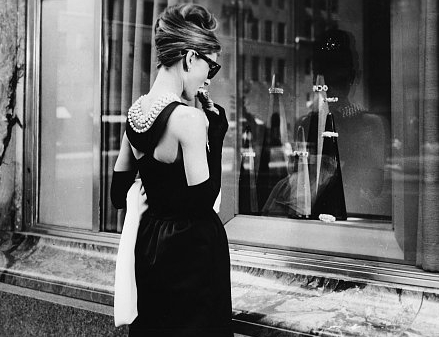
I found it very intriguing and almost comical how Holly’s poise and elegance at her party was replaced by her endearing hectic and scattiness in-between her ‘appearances’. I was drawn in by Holly’s breathtaking beauty and glamorous style from the very first scene where she emerges from a yellow taxi wearing a fitted black dress, pearl necklace, polished up-do and oversized sunglasses and from that point I knew she would be a style icon to remember. I love the overall story of the film of a girl who thinks that money will make her happy but learns that love is the real key to happiness because it is a real lesson to be learned in every time period. 
I felt that Holly’s former husband, Doc Golightly’s character, could have improved his articulation as I found him difficult to understand completely, which I found frustrating. I also found the ending of the film was quite abrupt and an anticlimax; I felt that maybe clips of their happiness in the near future together could have been shown, with Paul’s possible success with his writing and if Holly ever got a job. I basically felt like the ending wasn't much of a conclusion of the film. 

Style influences

I think that the iconic look of Holly in the black Givenchy dress made the film iconic and I think that this whole look started a new style movement. 
Beauty bloggers and YouTubers are still, to this day, recreating the Breakfast at Tiffany’s look, showing what an impact it had in the beauty industry. Lisa Eldridge did a recreation of Holly’s look after it was so highly requested by her fans and takes you through a step by step tutorial of how to achieve the 1950/1960s look. 
The focus of the makeup look was her eyes; she therefore wore black or brown winged eyeliner and the occasional bit of grey eyeshadow for depth. She also wore very feathery and pretty looking false eyelashes to emphasise her eyes further. All these features would be lighter in the day and more intense in the evening scenes. Her skin was always perfected and porcelain looking, with a pretty pink blush at all times, but never any bronzer, which has become a very popular look in many fashion shows and red carpet looks. Her eyebrows weren’t as intense or black as in her previous films, they were kept more soft looking and lighter in colour, to further emphasise her doe shaped eyes. Audrey’s character, Holly, would never be seen with a glossy lip and would always opt for the matte/satin finish, keeping her look very classy, simple and sophisticated.  
Audrey Hepburn really gave the ‘little black dress’ its name after wearing two black dresses in the film over again, but changing the look by adding different accessories and after 50 years it is still a popular staple to have in your wardrobe. She adapted the little black dress for different occasions four times, showing how versatile the dress can be and how it is a staple. Holly did tend to re-wear her different pieces of clothing,which would have made sense since she was struggling with money at the time, but she managed to make each outfit look different with her clever use of accessories to either dress up or dress down an outfit or to simply change the look all together, emphasising the power of accessories and giving them their own importance. Some of the most iconic accessories from the film would have to be the necklace of strands of pearls, the long black gloves, the oversized sunglasses and the jewels in her hair. 
The bold and oversized sunglasses worn by Audrey Hepburn in the film were by Oliver Goldsmith and were called ‘The Manhattan’ and for the Breakfast in Tiffany’s fiftieth anniversary this famous style of sunglasses was re-launched in celebration, emphasising again how the fashion from the film still influences the fashion of today. 
Another accessory, and some say the most iconic accessory of the film, was her character defining prop, the cigarette holder. This was very glamorous in the 1950s and so would have portrayed a wealthy and elegant image. An advertisement has recently been created to advertise E-cigarettes with a look-a-like of Audrey Hepburn’s character, Holly Golightly, to try to bring back this glamour associated with smoking.  
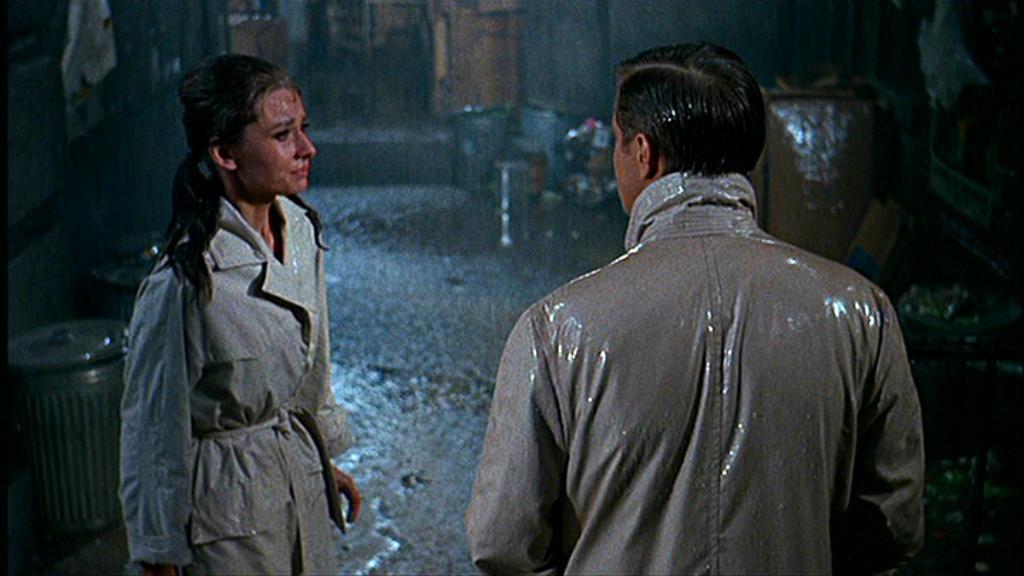
Another piece of clothing that made a statement and is still very popular today is the trench coat, which she wore in the last few scenes with Paul. Trench coats are always being seen on high fashion catwalks and they are also a high street favourite. This again highlights how iconic the character’s style was. 
Givenchy was already a highly respected fashion designer in Europe, however his designs for the film Breakfast at Tiffany’s, particularly the little black dress, propelled him into the high fashion world in America and Hollywood. Givenchy was the first high fashion designer to get into costume design in film, having previously worked with Audrey Hepburn in films ‘Sabrina’ and ‘Funny Face’ and the both became very good friends. 
Breakfast at Tiffany’s made Audrey Hepburn a fashion/style icon in her own right. Her look in the opening scene with her little black dress and bold accessories can be recognised all over the world and a photo of her in that ensemble instantly make people think of the film. The propelled Audrey into the limelight and through that she really made a name for herself, going on to star in many other famous films, such as My Fair Lady and How to Steal a Million. 

Makeup Department 

Nellie Manley - hair style supervisor
Wally Westmore - makeup supervisor

Costume and Wardrobe Department 

Hubert de Givenchy - principal wardrobe: Miss Hepburn
Edith Head - costume supervisor
Pauline Trigere - principal wardrobe: Miss Neal
Joan Joseff - costume jeweller (uncredited)

The makeup and costume departments in Breakfast in Tiffany’s looks like it is a lot smaller than in the Great Gatsby; however I don't know whether this is down to not all the staff being listed or whether smaller groups of people were needed. 

I think the Breakfast at Tiffany’s film was iconic in terms of fashion and style because the image of Audrey Hepburn styled as Holly Golightly in the black Givenchy dress, bold accessories and her cigarette holder (as shown below) is one of the most  recognisable images, worldwide, of all time. The film is so iconic that it was shown, at the beginning of September, on the very first day of the Selfridges new cinema opening in London. Many recreations have been made of this iconic image of Audrey Hepburn, again showing how influential the film’s styling had been, some of which are shown below.  


Tuesday, 30 September 2014

The Great Gatsby

The Great Gatsby (2013)

The 2013 film, The Great Gatsby, was based on the 1925 iconic novel by the American author, F Scott Fitzgerald, and was the sixth interpretation to be made of the original novel. The first film version of this novel was made in 1926 and was a silent movie of a stage production. 

When the 2013 film was first released it was not reviewed highly by the critics, however it was very popular with its audience and is the director’s, Baz Luhrmann, highest grossing film to date. The film went on to win many highly respected awards such as Best Costume Design, Production Design and Best Actor in a Leading Role at the AACTA Awards. 


Review

The Great Gatsby is a high glitz, high glamour 1920s film that follows a young man, Nick Carraway, who moves to New York City, in the summer of 1922, to chase his big american dream. He finds himself next door to the mysterious millionaire Jay Gatsby and across the pond to his beautiful cousin, Daisy Buchanan, who is married to the unfaithful, self-important and well off Tom Buchanan. Nick becomes engulfed in the world of alcohol, drugs and sex, showing the audience the rebelling of morals of the times. Gatsby is on a mission to win back the heart of his old flame, Daisy, with the help of Nick, having pulled out all the stops to create the perfect palace for him and his ‘princess’.

I really enjoyed the film; however I did think it was too long, developing slowly. I liked how Nick narrated his memories to his doctor in the ‘present’ day because it was interesting to see how his experiences affected him and changed him as a person. I thought that Leonardo DiCaprio performed his character, J Gatsby, with power and authority and I loved how his obsession with Daisy drew him to revolve his life and goals around his love for her. I liked how the rich and vivid colours used added to the extravagance and wealth being portrayed and how the opulence and glamour was shown through the stunning costumes and excesses of his lifestyle. Although I felt that parts of the film were slow, I loved how fast pace the concluding scenes were and how they mirrored the panic and agitation of Gatsby’s emotions. I thought the scene showing Gatsby’s funeral was a very powerful and emotional ending, with only Nick and the press showing up, concluding that all the characters cared about was their wealth and reputation. I love how current music from artists  such as Jay-Z, Beyonce and Will.I.Am were incorporated into the 1920s film, keeping with the very distinct style of the director Baz Luhrmann, because it gave the film more of a modern twist.


Style Inspiration

The 2013 Great Gatsby film was a 3D romantic drama. 

The Great Gatsby novel mirrored the society of the time, its style and attitudes. The 2013 film version also mirrored the society of the 1920s, however when the film was released it did influence and inspire fashion from the high street to designer clothing.  

Prior to the 1920s, women had to cover up their legs but accentuated their curves, aiming for a very womanly and curvy figure; however this changed through the 1920s and the ideal figure became more boyish and women wanted to have a flatter breast and less accentuated hips and waists. The iconic flapper dress was more comfortable with the short pleats and the top flattened the breast instead of pushing them up and the low waist also covered their small waists and smoothed out their hips. Women also began to cut their hair short into bobs to fit the popular cloche hats. 
Coco Chanel was one of the most influential women in fashion through the 1920s, being the first women to cut her hair short, wear trousers and reject wearing the corset.  


The makeup in the 1920s was also very stylised with the highly-arched eyebrows, bold eyelashes, bright pink cheeks and perfected porcelain skin. Women were encouraged to wear more makeup by magazines such as the French Beauty Industry so that they looked their best when trying to compete with men for jobs. Lipstick became very popular and many different varieties were invented to make the application of lipstick as easy as possible. Women wanted the perfect lip shape, which they associated with having a very defined cupids bow. 

The styling in the Great Gatsby film followed these trends with all the main female characters having short hair and flattened breasts and smoothed out hips. 

When making the 2013 film they collaborated with the very highly respected designers Prada and Miu Miu and with Brooks Brothers to come up with modernised versions of what was worn in the 1920s, such as the fact that they emphasised Daisy’s breasts with a push-up bra, instead of flattening them, which was the popular thing to do in those times. The costumes in the film, in general,  were more sexualised and modernised to suit the viewing public. 

The film also collaborated with Tiffany’s, using pieces from their archives and designing new pieces appropriate for the era. The film worked with MAC for the cosmetics used.  


After working with the film, Tiffany’s and Brooks Brothers released their own collections inspired by the styling in the film in anticipation that the film would influence the fashion today, which proved to be a successful predication. 

Other top designers such as Hackett, Canali, Vera Wang and Alexander McQueen were also influenced by the film’s style and released collections inspired by the 1920s look. It was not just the top designers that were being so highly influenced, high street retailer Debenhams saw a dramatic increases in sales of period pieces; in fact the  sales of period accessories such as head pieces and feather capes were up by over 250 per cent off the back of the film and the 1920 costume jewellery went up by 200 per cent. Michelle Dowsall, Debenham’s spokes person was quoted saying, ‘Twenties style regalia is back!’. 

Even the top fashion magazine, Vogue, released an issue inspired by The Great Gatsby, recommending different beauty and makeup products that would help readers get the perfect modernised Daisy Buchanan look. They also did a cover of Carey Mulligan, who played Daisy Buchanan, again showing the importance and influence of the film. 


The fact that all these leading designers, high street retailers and fashion magazines have brought out  collections and/or articles inspired by the 2013 Great Gatsby film shows that the film did greatly influence the current fashion styles of today.


I didn’t feel like the Great Gatsby made either Carey Mulligan or Leonardo DiCaprio a style icon, as I felt that they were style icons in their own right before the  film was released. Carey Mulligan was nominated for an Academy Award from her performance in the 2009 film, An Education. This was her break through film that really got her noticed in the acting and fashion world. At her first Oscars she wore a Prada gown that wowed and she was at the top of many best dressed lists; she has continued to wow at red carpet events with her sophisticated, but edgy looks. Leonardo DiCaprio was also a style icon before the Great Gatsby after he played the lead in the iconic, world famous Titanic and other major film roles.


For me, the most memorable look that defines the film is when Daisy wears the jewelled gold dress, glistening hair accessory and furry stole. The rich colours and extravagant diamonds and fur represent how glamorous and over the top the film’s styling is and how money is the one thing that mattered to the characters.  

To make the film such a visual success, over 30 people worked together in the makeup department; however the key makeup artist was Wizzy Molineaux and the key hair stylist was Ashley Johnson. Other makeup artists included Lara Birch, Luann Claps, Sian Grigg and Matteo Silvi and some other hair stylists included Kalotina Amperidis, Kathryn Blondell, Teresa Hinton and Joani Yarbrough. 

There were nearly 50 people working in the costume and wardrobe department, lead by the costume designer Catherine Martin, including Whitney Adams, who was  the costume design assistant, Julie Barton who was the key costume stand-by, Natalie Bracher, who was the textile artist and Bronwyn Doughty who was the costume department coordinator. 


I think that the 2013 Great Gatsby film was iconic because, firstly the original novel was iconic, and also because the two leading roles of J Gatsby and Daisy  Buchanan were played by highly respected actors/actresses with reputations to uphold. I think the styling and production of the film made it iconic with the rich and bold colours showing the extravagance and opulence of the 1920s; I love how the society and style of the time was captured through the grand visuals like the diamond chandeliers, huge manors and beautiful and glamorous wardrobe.